
VBC & PE: A Match Made in DC
The House of Private Equity Always Wins

In the last three newsletters, I used my Value-Based Care (VBC) simulation model to discuss the long-term sustainability of independent ACOs and PCPs in these payment models. The central challenge is that ACOs require significant upfront capital and administrative overhead to operate under VBC and therefore need a funding source. However, given benchmark ratcheting and other structural constraints, most ACOs will fail within a decade.
If you have not “played” with the simulation model, I highly recommend doing so using the link below.
In this newsletter, I will look at why VBC is the perfect vehicle for Private Equity (PE) investment, i.e., ACOs are high risk, but the return on investment (ROI) can easily be 1000%.
Let’s dive in.
The video version of this article is embedded below and available on my YouTube Channel.
The audio podcast and video versions are also available on the Podcasts Page.
If you read my previous articles or are familiar with the simulation model, feel free to jump to Step 4 below.
The Simulation Model
There are 6 steps in the model. Each step has several variables that the user can adjust. I have made baseline assumptions for each variable, including worst-case, realistic, and best-case scenarios. In addition, many variables include tooltips that explain their meaning.
For this article/demonstration, I will follow the realistic scenario in the VBC Simulation Model.
Steps 1-3
Step 1: Setup: Allows the user to choose the ACO size and baseline contract terms.
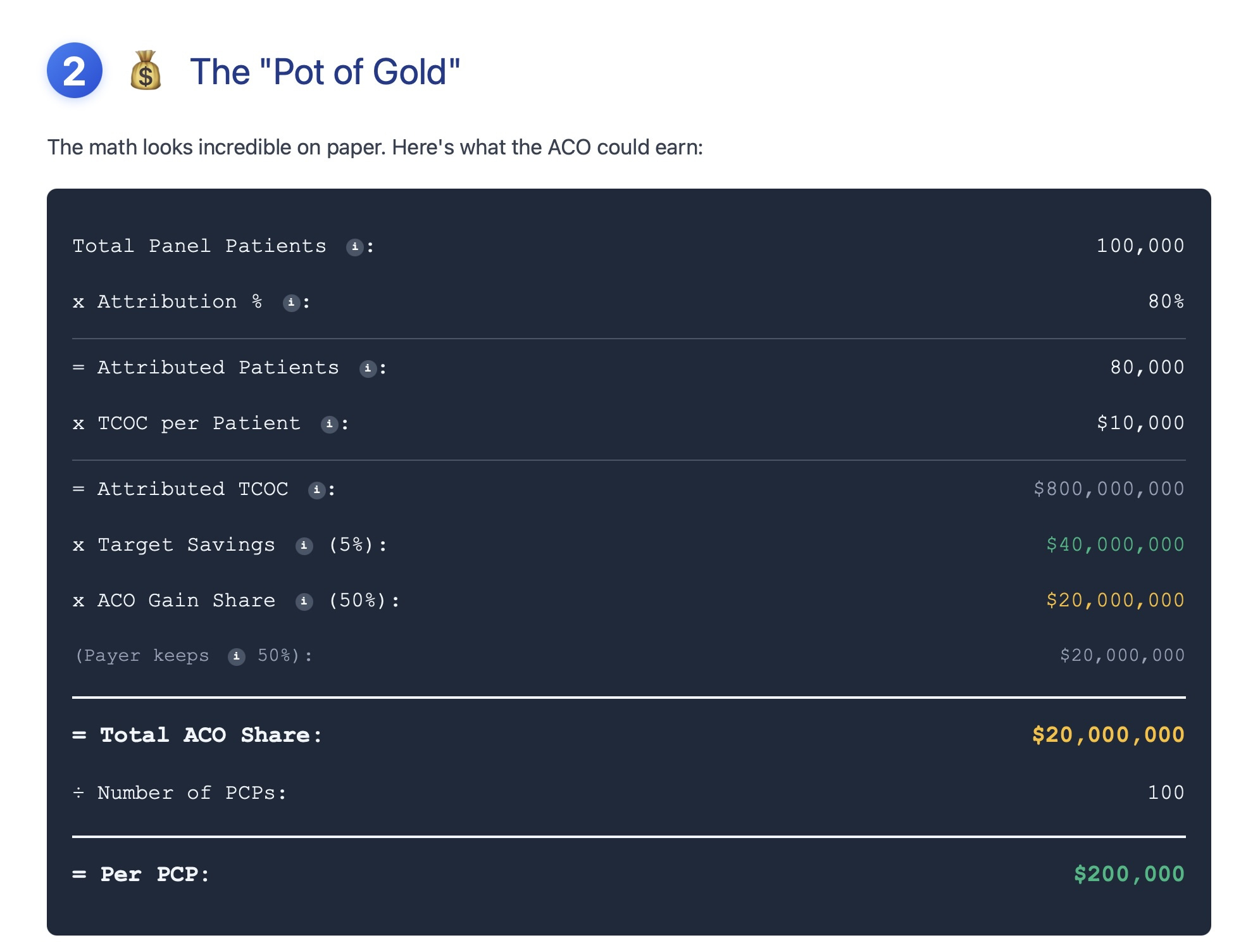
Step 2: Opportunity (Pot of Gold): Shows the back-of-the-envelope ACO savings opportunities based on the assumptions in Step 1.
Step 3: Reality Sets In: Simulates the costs of setting up the ACO. This step also includes the PCP’s financial burden from the added administrative tasks.
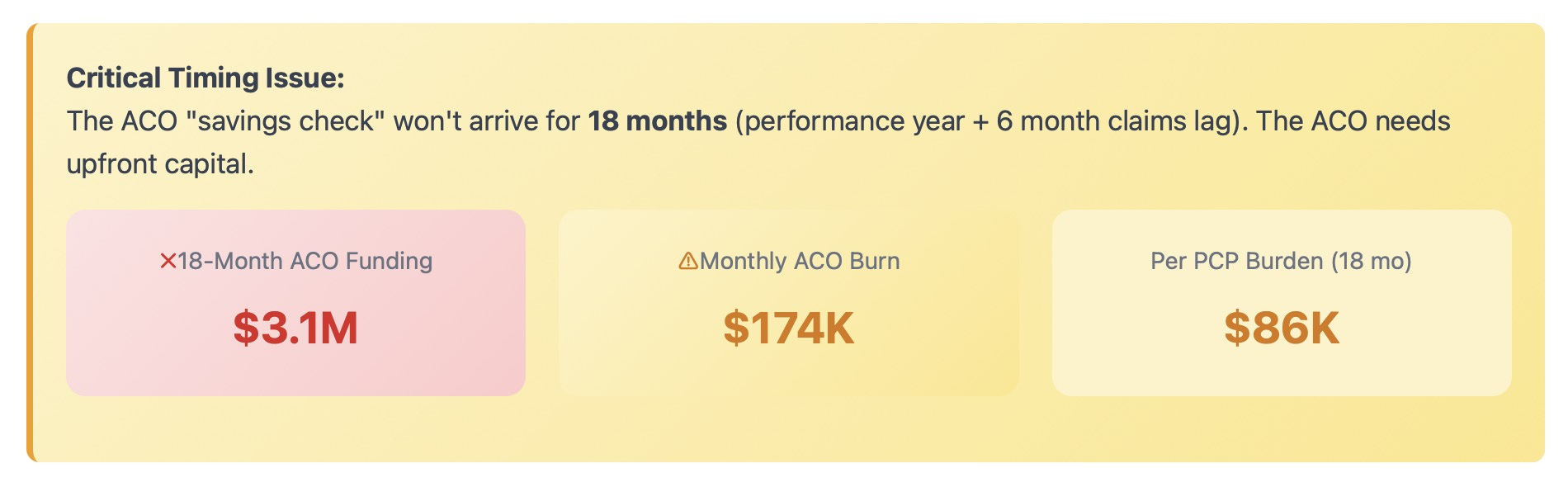
By the end of Step 3, our newly formed ACO needs approximately $3.1 million for the first 18 months to function. In addition, individual PCPs have lost the opportunity to earn approx $86K in these 18 months.
Step 4: The Funding Decision
With $3.1M needed to operate the ACO, the next question is: who provides the capital? In this step, we decide which funder to choose from:
Bank Loan
Hospital partner
Payor Advance (as pmpm)
Private Equity
When we choose the PE option, we get the screen below.
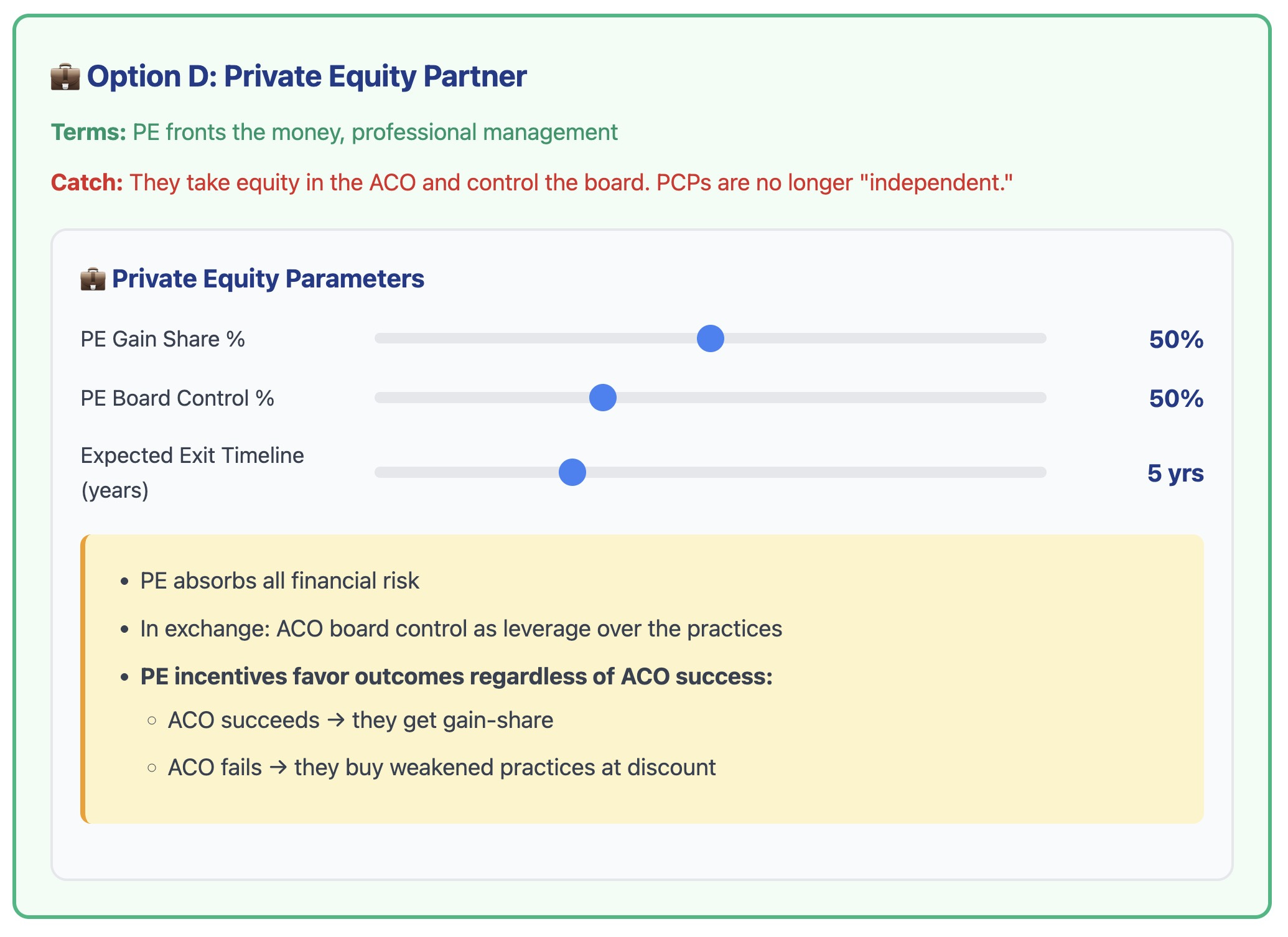
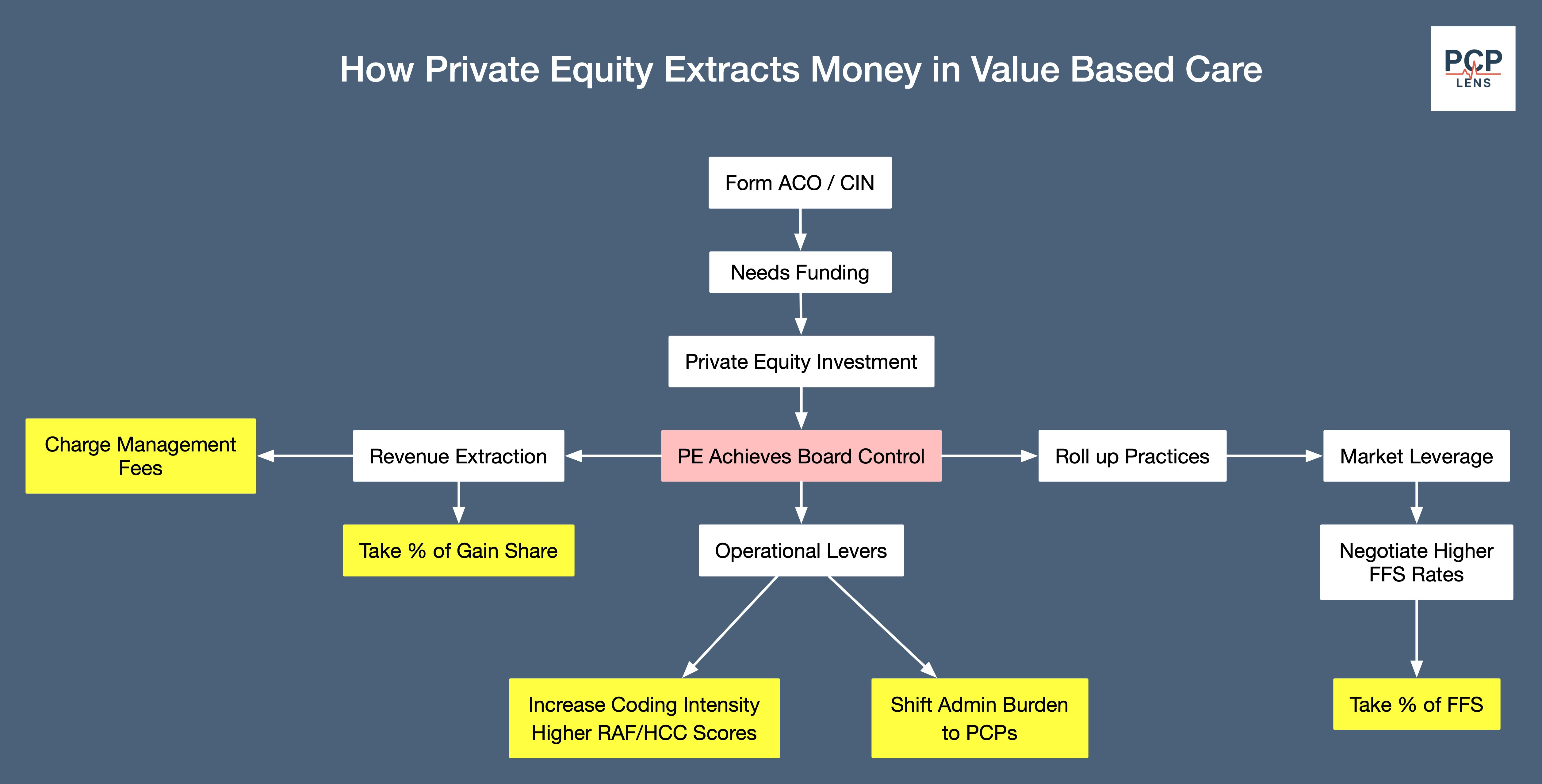
Now, right off the bat, when a PE firm invests in an ACO, they want to make sure they not only get their money back but also achieve outsized returns before the ACO fails. To do this, PE companies have several levers they can pull, such as:
Taking a piece of the gain share.
Charging management fees.
Board control: This allows PE firms to decide how the investment will be used. This manifests in several ways:
More investment to ensure higher RAF/HCC scores, thereby increasing the benchmark.
Higher administrative burden on PCPs to collect and submit data.
Restructuring the ACO so that “high-performing” PCPs are in higher risk contracts, such as ACO REACH, while “lower-performing” PCPs are in lower risk contracts, such as MSSP.
Rolling up independent medical practices into a Clinically Integrated Network to negotiate higher fee-for-service (FFS) commercial insurance rates with payors, and skim a percentage off the top.
This transfer of health insurance dollars from clinical care to PE companies is shown below.
With this background, let us look at what happens if the ACO succeeds or fails.
Step 5: Year 1 Outcomes
Let us first look at what happens if the ACO succeeds in hitting its target by decreasing TCOC by 5% and saving $40M.
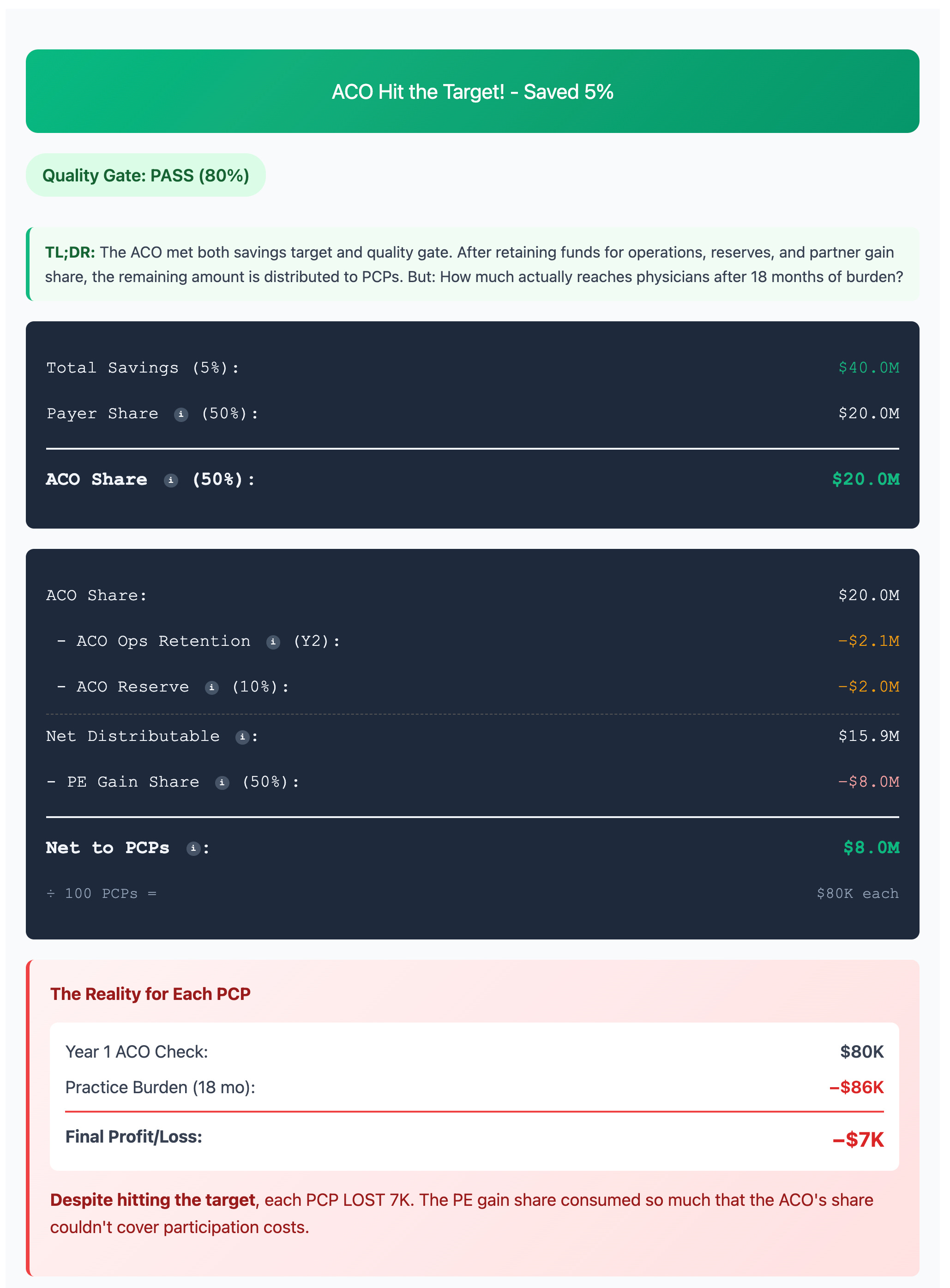
If you follow the money in the calculation above, you will notice 3 themes:
The ACO saves enough money to fund itself for the next year
PE companies take 50% gain share after ACO operating expenses and reserves
Independent PCPs receive a hefty $80k gain share
At first glance, this looks like a win-win-win situation. However, if we look closely, we will see the problems:
PE fronted approx $3.1M, and already in Year 1, they made a profit as they received $8M in gain share. This means that effectively, every year onwards, the ACO becomes a profit-extracting machine for PE companies — not just from gain share, but from all the levers I mentioned above.
The independent PCPs, despite receiving $80k in gain share, still lost money due to administrative burden and opportunity cost.
Therefore, even when the ACO succeeds, independent PCPs lose money and eventually consolidate.
Now, let us look at what happens if the ACO fails.
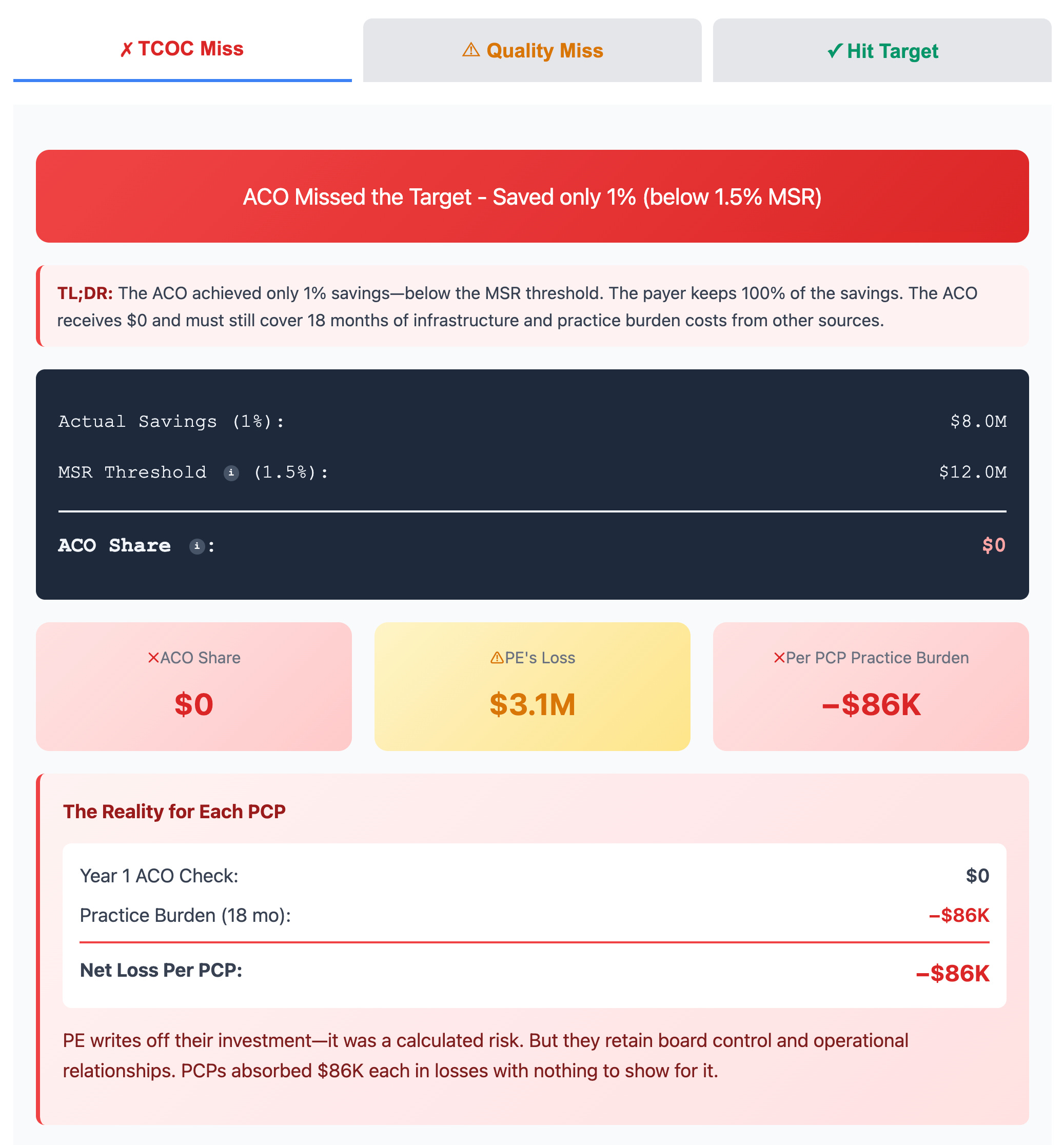
If the ACO fails, it appears at first glance that the PE company lost money. But remember, the PE company spread its risk across multiple ACOs. Often, they need only a few ACOs to succeed and make a profit.
Furthermore, if an ACO fails, PE companies have other levers to recoup their losses:
Often, the “money invested” was debt taken in the name of the ACO. Therefore, if the ACO fails, the PE company can declare bankruptcy and walk away from the debt.
An aggressive form of this technique is called Dividend recapitalization, in which PE takes on a large loan secured by projected future revenue. This cash loan is used to pay a “special dividend” to the PE company, allowing it to recoup its investment even before the performance period starts! The ACO is saddled with debt and interest payments, making it almost impossible to succeed.
Consolidate failing independent PCP practices into larger employed practices and pivot to creating regional monopolies to negotiate higher FFS rates with payors.
Consolidate and sell off failing independent PCP practices to the highest bidder.
Sale-leaseback transactions force doctors to sell the real estate clinics that they may own to Real Estate Investment Trusts (REITs) and then lease them back, saddling doctors with high rent payments.
PE companies are the gambling houses of healthcare, and the house always wins.
Step 6: Multi-Year Projections
So what happens if the ACO continues to succeed for several years? Let us look at the screenshot below.
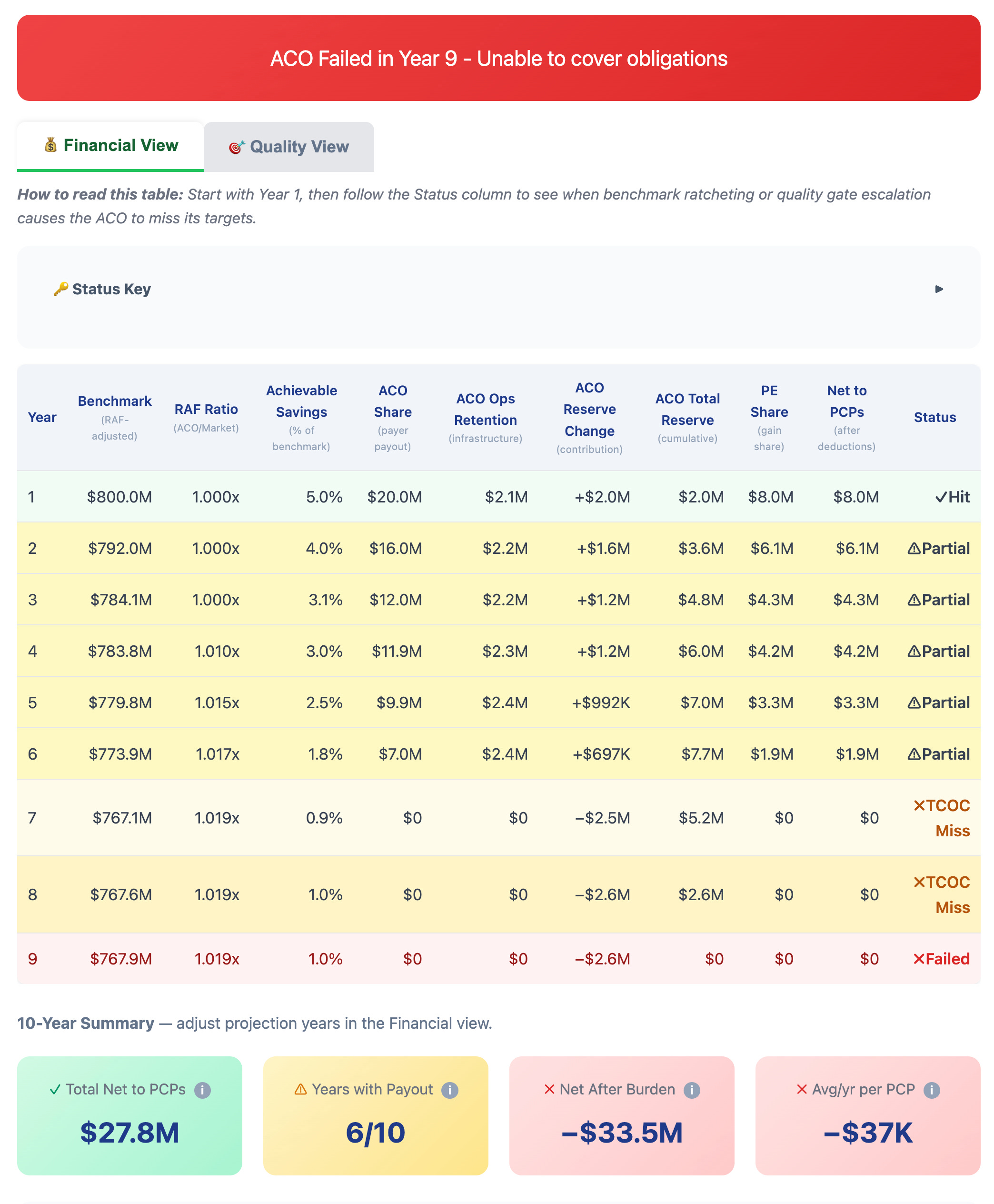
Eventually, most ACOs will fail. In the screenshot above, you can see that PCPs lost an average of $37k/year.
Now, let’s add up the PE gain share for the 6 years in which the ACO succeeded.
Total PE gain share = $27.8M.
That is almost 900% ROI in 6 years. Once you account for the other levers of profit extraction I mentioned above, the ROI is close to 1000%. This is why PE is so interested in funding ACOs.
Final thoughts
Just like primary care, most ACOs are loss leaders in the larger healthcare enterprise due to the large capital required to operate ACOs. The only difference between a small PCP practice and an ACO is scale!
And to understand the loss leader model, you have to follow the money. Therefore, whoever is funding the ACO is more interested in downstream profit extraction, which, to be fair, is a function of capitalism.
But I am not here to judge capitalism. I think capitalism is one of the best economic systems. However, contrary to the prevailing narrative that VBC saves money, the perverse incentives created by this payment model ultimately destroy independent practices, which are cheaper than large, consolidated health systems.
You can play with the model here.
I am working on the next version of the model and would love to hear your feedback.
Hey — I came across your writing and really liked how you think.
I’m exploring something similar from a different angle — writing about human behavior through a system design lens (like debugging internal patterns).
Just started publishing on Substack. If you ever get a moment to read, I’d genuinely value your perspective.
Also happy to support your work — feels like there’s an interesting overlap here.
So for a small practice going forward - best path is some sort of subscription model? This avoids insurance companies and VBC funding . But it then presents many issues with demographics of your population , viz, you will self select for better paying patients in order to remain afloat . We primary docs CAN retain lower income patients and do our own work supporting those who cannot pay enough . This takes me right back to when I began in 1985 in a rural county in the mid Atlantic region.When we started , we did not even participate with Medicare ( patients could of course submit on their own for reimbursement ) . And we knew there were just some patients who would not / could not pay much or at all. So we collected more from those who could . Dr B you are bursting my bubble - I saw the ACO/PHO ideas as ways small practices COULD participate in a more socialized set of costs ( dealing those who had less to pay ) without having to go the full concierge / subscription route. For all their bad points and possible corruptions , the ACOs do have a population based approach.